
About
Schedule
18:00 Open Doors
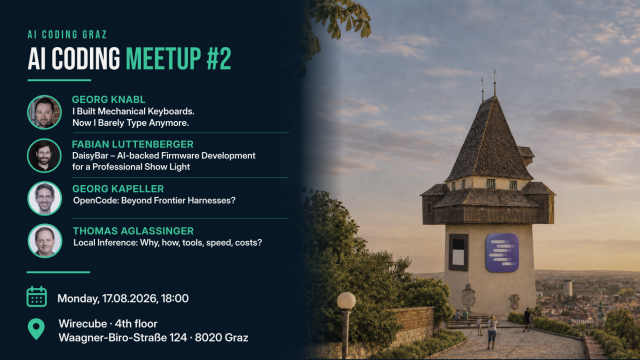
18:30 Talk "I Built Mechanical Keyboards. Now I Barely Type Anymore."
19:00 Talk "DaisyBar – AI-backed Firmware Development for a Professional Show Light"
19:30 Break
19:45 Talk "OpenCode: Beyond Frontier Harnesses?"
20:15 Talk "Local Inference: Why, how, tools, speed, costs?"
20:45 Food/Drinks & Networking
Networking will again be facilitated by Simon's awesomely vibed Matchup-App :)
Talks
Georg Knabl
I Built Mechanical Keyboards. Now I Barely Type Anymore.
Dictation has been around for decades, but few developers consider it part of their core workflow, as nobody wants to speak code syntax aloud. Agentic workflows and spec-driven development change that.
In his lightning talk, Georg will demonstrate how he uses voice to interact with coding agents, maintain websites, and handle everyday communication, while also discussing productivity, privacy, and the limits of a voice-related workflow.
Fabian Luttenberger
DaisyBar – AI-backed Firmware Development for a Professional Show Light
DaisyBar represents a new generation of professional show lights, combining high-performance hardware with a modern, AI-assisted development approach. Fabian will demonstrate how wirecube electronics used Claude Code to develop a large part of the DaisyBar firmware – from LED driver control and system configuration to the boot system, calibration, and test GUI.
Georg Kapeller
OpenCode: Beyond Frontier Harnesses?
Frontier coding harnesses provide polished, deeply integrated experiences. But that integration comes at a cost: model, harness, and workflow are tightly coupled within a single-vendor stack.
OpenCode takes a different approach: a highly configurable harness for mixing providers, subscriptions, free models, and task-specific subagents. This talk explores what that freedom enables, how OpenRouter and OpenChamber fit into the setup, and where a model-agnostic approach still falls short.
Thomas Aglassinger
Local Inference: Why, how, tools, speed, costs?
Running open-weight LLMs locally are increasingly becoming an option to cloud models. Typically motivations to do so are data sovereignty, reliability, or unrestricted models. But what hardware is needed to achieve reasonable quality and performance? Which free or open source tools are proven choices for local LLM services? What are the popular models for common tasks such research and coding? What kind of speed and cost can be expected, and how does this influence personal Workflows compared to cloud models? After the talk, attendants should be able to decide when local inference can already be helpful in their current projects, and for what they still might prefer to wait before them becoming viable for their specific situation.
Comments

#2 AI Coding Meetup Graz


